Zoho MCP: Launching the future of work

Picture your SDR’s Monday morning.
A deal just closed. Normally that means: update the CRM record, create a Books invoice, open a Desk ticket for onboarding, send a welcome email from Mail, and message the CS lead on Slack. Those five apps can take you fifteen minutes, and the process repeats with every other deal that comes in.
What if you could do that just by prompting? "Paul just signed. Update his CRM record, create an invoice, open an onboarding ticket, send him a welcome email, and ping the CS lead on Slack." Or once you've told your agent what "setting someone up" means for your team, you just say: "Paul just signed. Set him up."
Or picture your finance team at month-end: chasing approvals in Mail, cross-checking entries in Books, updating the status in Projects, and downloading reports from WorkDrive to paste into a spreadsheet someone will ask you to redo anyway. That's four apps and hours of work.
What if you could do that just by prompting, too: "Close out October. Pull the numbers, flag anything over budget, and send the summary to the leadership team."
Done.
According to Harvard Business Review, the average worker toggles between apps roughly 1,200 times a day. That’s nearly five full working weeks a year, lost to nothing but app hopping and context switching. This is what work looks like when your tools don't talk to each other.
Today, we’re changing that forever.
Introducing Zoho MCP
Every transformative computing shift has needed a shared protocol before it could scale, one that lets independently built systems talk to each other without asking permission. HTTP made the web interoperable. SMTP did the same for email. MCP (Model Context Protocol) is the shared communication protocol that lets AI agents take action across your stack.
AI and agents are powerful, but without interoperability, they stop at insight instead of action.
That's the gap Zoho MCP closes. Zoho MCP connects your AI models, your apps, and your data into one intelligent system so your agent doesn’t just understand your instructions; it executes it.
See it in action ↓
"Mark the Zylker deal as won and schedule a call with John for an onboarding meeting"
Auto-update deals, trigger follow-ups, and log meetings.
"Schedule a campaign called 'Summer Sale Blast' for next Tuesday at 11 AM and target all leads from Bangalore."
Generate campaign reports, launch workflows, optimize content.
"Search the desk for any open tickets. Mark them as in progress and send a reply that we are working on it and will update by end of the day."
Escalate tickets, summarize threads, and auto-assign queries.
"Generate an invoice for Naveen Kumar from ABC Corp for ₹1200 on consulting services."
Generate invoices, track payments, log expenses, and create financial reports.
Three things Zoho MCP makes possible for the first time:
Instead of switching tabs or writing scripts, you simply tell your AI what to do and MCP makes it happen. With this approach, your apps can:
Share context across your entire stack: Your AI finally understands that Priya in CRM is the same Priya with an overdue invoice in Books and an open ticket in Desk. Because MCP gives every tool a standard way to expose its data, your AI assembles one coherent view of every customer, every account, and every workflow without you stitching it together manually.
Natural language workflow orchestration: Just state your intent: "Renew the contract, update the record, generate the invoice, and schedule a follow-up." With help of MCP, LLM can orchestrate across multiple zoho apps seamlessly.
Model-agnostic by design: Model lock-in is a real concern when building on AI, but Zoho MCP is model-agnostic by design. It works the same way regardless of which LLM you choose.
Across Zoho and beyond
Connects with Zoho ecosystem: CRM, Desk, Books, Mail, Calendar, WorkDrive, and Projects Wider world: Slack, Gmail, Notion, Salesforce, and 300+ third-party tools | Compatible with
|
How it works
The tech under the hood is powerful, but using it is simple.
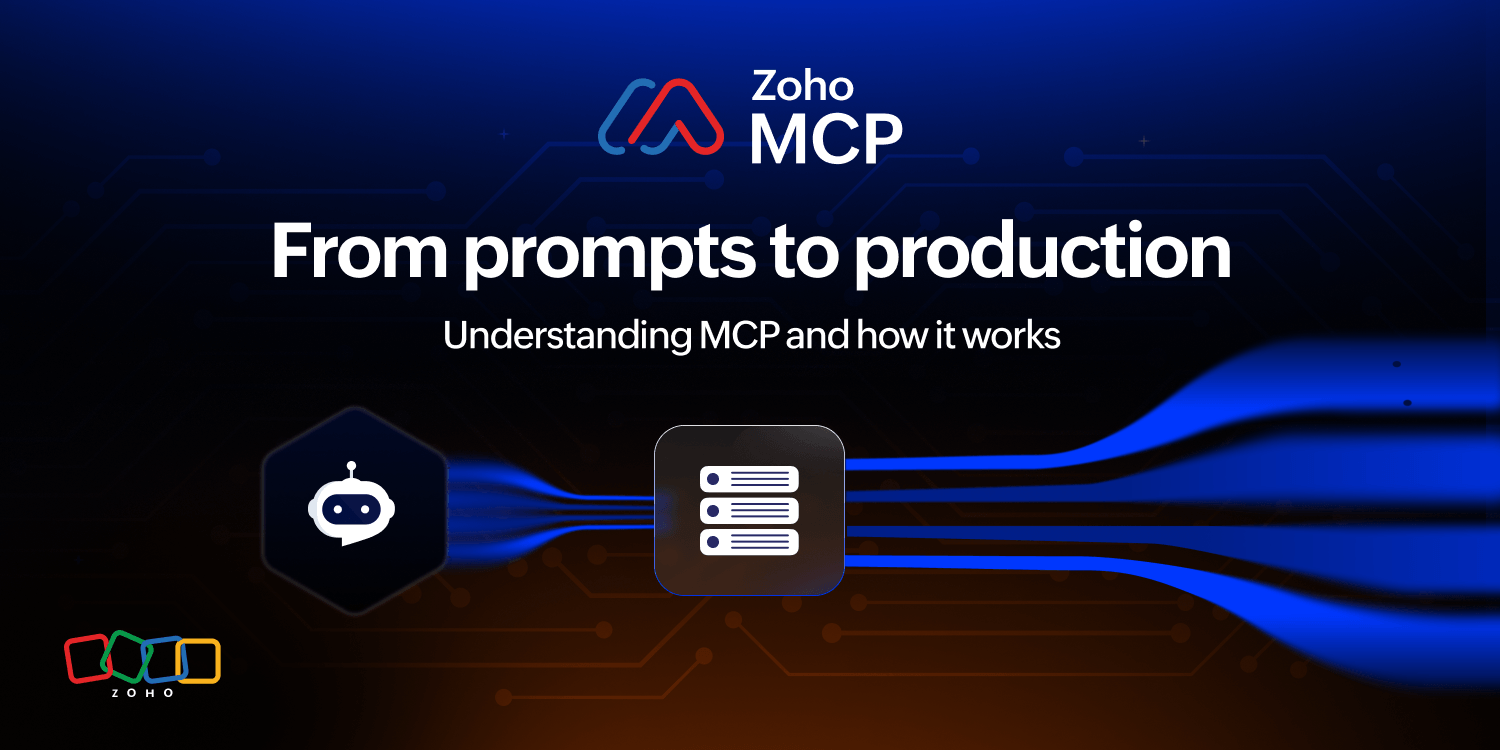
You send a natural prompt to your AI model (GPT, Claude, or an in-house LLM).
With MCP, the AI model then decides based on the available tools and services and chooses the right service to interact with.
MCP tool then proxies the respective Zoho API tool to fetch data, perform action, and send back response to the API Model.
Each workflow that once took dozens of clicks now happens in seconds, thanks to MCP’s wide range of services and tools that enable Gen AI to become Agentic and manage your Application data. Just one prompt sets everything in motion.
Why it matters
By enabling AI interoperability across your ecosystem of apps, MCP unlocks a new class of efficiency and autonomy:
From hours to seconds: Automate multi-app tasks instantly with AI-driven workflow automation.
From silos to unified systems: Unify data and context without migrations.
From tools to actions: Your AI agents don't just surface information—they act on it, executing multi-step workflows across your stack without human handholding.
The future of work is interoperable
The future of work will not be defined by better apps. It will be defined by apps that work together. The era of tab-switching, copy-pasting, and manual handoffs is over. With Zoho MCP, every tool in your stack becomes something bigger than the sum of its parts—an interconnected system where your AI understands context, makes decisions, and acts across every tool on a single prompt.
With Zoho MCP, turn your apps into an intelligent team that any AI agent can access, query, and act through in real time.


Comments