WhatsApp BSUID explained: What it means for business messaging

For most of WhatsApp's history, knowing who you were talking to was fairly straightforward: there was a phone number.
A customer messaged your business. Their phone number identified them. Your customer engagement platform could use it to associate conversations, connect records, recognize returning customers, and power workflows around that identity.
But that model is changing.
WhatsApp is gradually rolling out usernames, giving people the option to use a unique username when communicating on WhatsApp. When a user with a username contacts a business for the first time, their phone number can remain private unless they choose to share it. If the business already has that customer's phone number from an earlier interaction, it can continue to see it.
From a customer's perspective, the experience is simple: start a conversation without necessarily sharing a phone number. For businesses, however, it raises an important question:
If a phone number is no longer always visible, how do you reliably know who is on the other side of the conversation?
That is where Business-scoped User IDs, or BSUIDs, come in. But before we get into how they work, it is worth looking at why this change matters now.
So, what is a BSUID?
A Business-scoped User ID (BSUID) is a back-end identifier assigned to a WhatsApp user for their relationship with a particular business portfolio.
Meta introduced BSUIDs alongside its move toward usernames so businesses can continue identifying and communicating with WhatsApp users even when a phone number is not available. Meta describes BSUID as the new backend identifier used for users who adopt usernames on the WhatsApp Business Platform.
Think of it this way:
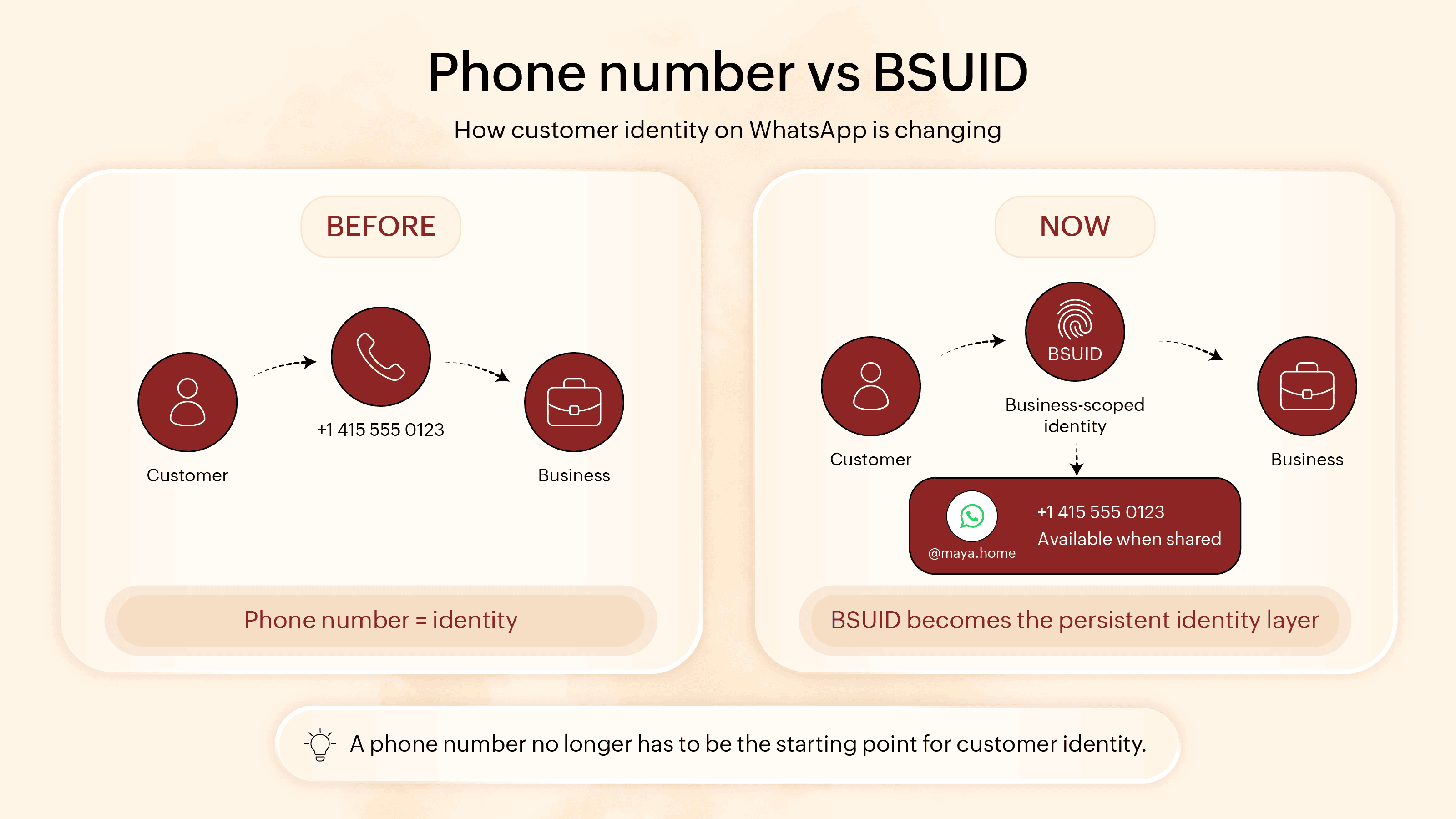
Previously
Customer → Phone number → Business
With BSUID
Customer → BSUID → Business
↳ Phone number, when available
The important distinction is that the BSUID is business-scoped.
It is unique to the relationship between that user and a particular business portfolio rather than being a universal identifier that follows the customer everywhere. Changing a WhatsApp username also does not by itself change that underlying BSUID.
For businesses, this provides continuity even when the customer chooses not to expose their phone number.
Why WhatsApp usernames change the identity model
WhatsApp usernames are optional, and a phone number is still required to create a WhatsApp account. What changes is what another person—or a business—necessarily gets to see.
When a user has set up a username, WhatsApp can let them interact without displaying their phone number to someone who does not already have it. Users can also explicitly choose to share their number later when necessary, creating a more privacy-conscious interaction model:
A customer can start a relationship with a business before deciding whether their phone number needs to become part of that relationship.
And that has implications well beyond WhatsApp itself.
Businesses that have historically used phone numbers as the primary key across customer engagement systems will increasingly need to account for conversations where another identifier is doing that job.
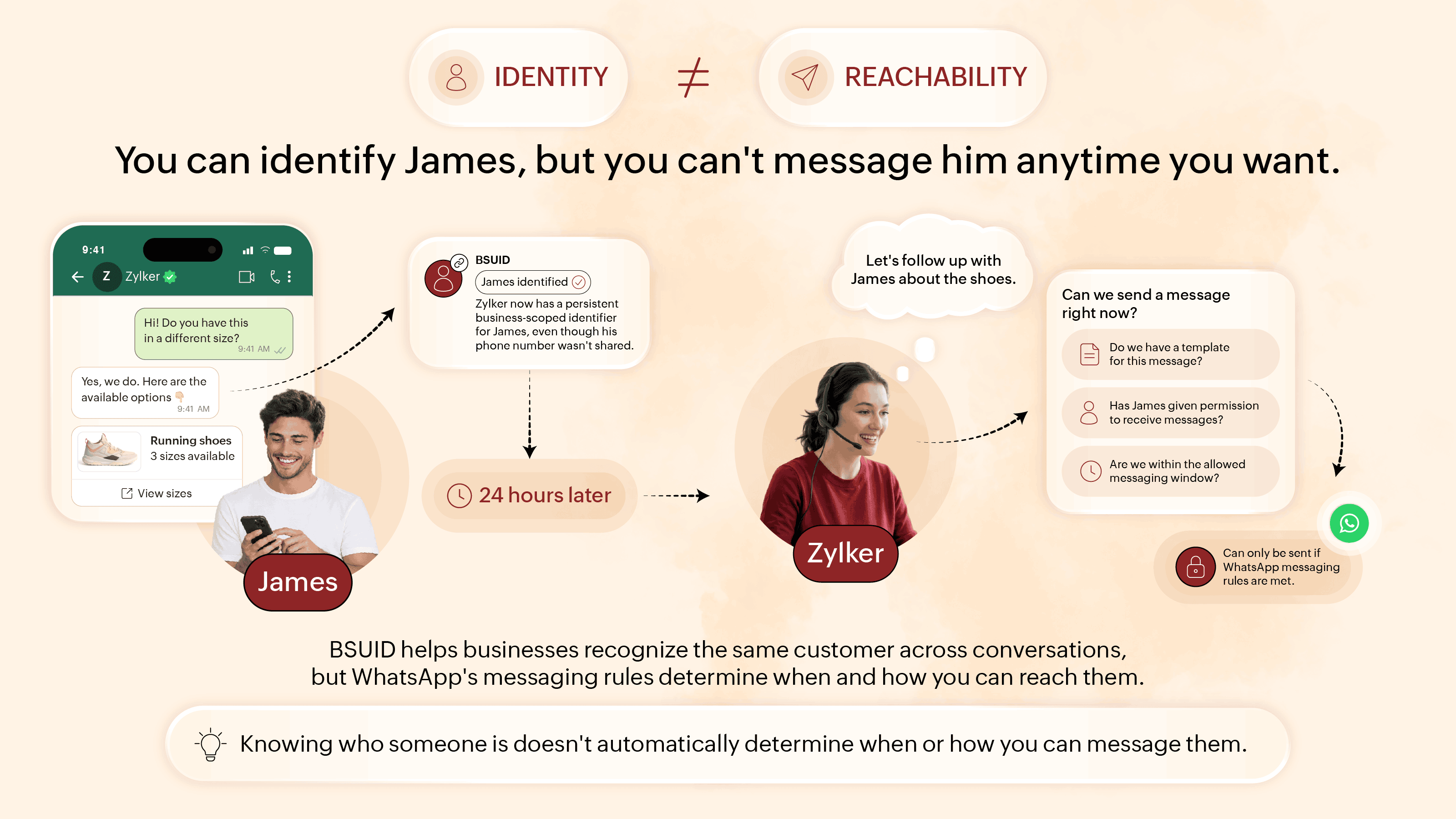
Identity and reachability are not the same thing
This distinction is important. A BSUID helps answer:
Who is this WhatsApp user in relation to my business?
It should not be interpreted as:
I can now contact this person in any way, at any time.
Identity and permission to communicate are separate concepts. WhatsApp's normal messaging rules, conversation windows, template requirements, user preferences, and other platform policies still apply.
Meta's current BSUID specifications also allow BSUIDs to be used for many messaging scenarios, while some authentication template types continue to require a phone number.
This distinction becomes increasingly important as businesses build automated journeys around WhatsApp.
A system may be perfectly capable of recognizing a returning customer through their BSUID while still needing to evaluate whether a particular outbound message is permitted and what identifier or template is required to deliver it.
In other words: Identification tells you who the customer is. Messaging rules determine how and when you can reach them.
What does this mean for customer engagement teams?
For an operator handling a WhatsApp conversation, very little should feel different. The bigger change happens behind the scenes.
Imagine a prospect clicks a Click-to-WhatsApp ad and starts talking to your business. They ask about pricing, discuss their requirements, and eventually become a qualified lead.
Previously, the phone number could naturally become the anchor for that interaction. With username-based interactions, the business may instead initially receive a BSUID as the customer identifier. That conversation still needs to be routed correctly. Context still needs to follow the customer. Automations still need to run. Information collected during the conversation still needs to reach the appropriate CRM, support, or business system.
The customer should not experience a broken journey simply because the identifier underneath that journey changed. That is ultimately why BSUID matters. It allows the infrastructure behind the conversation to change without forcing the customer experience to change with it.
A simple example
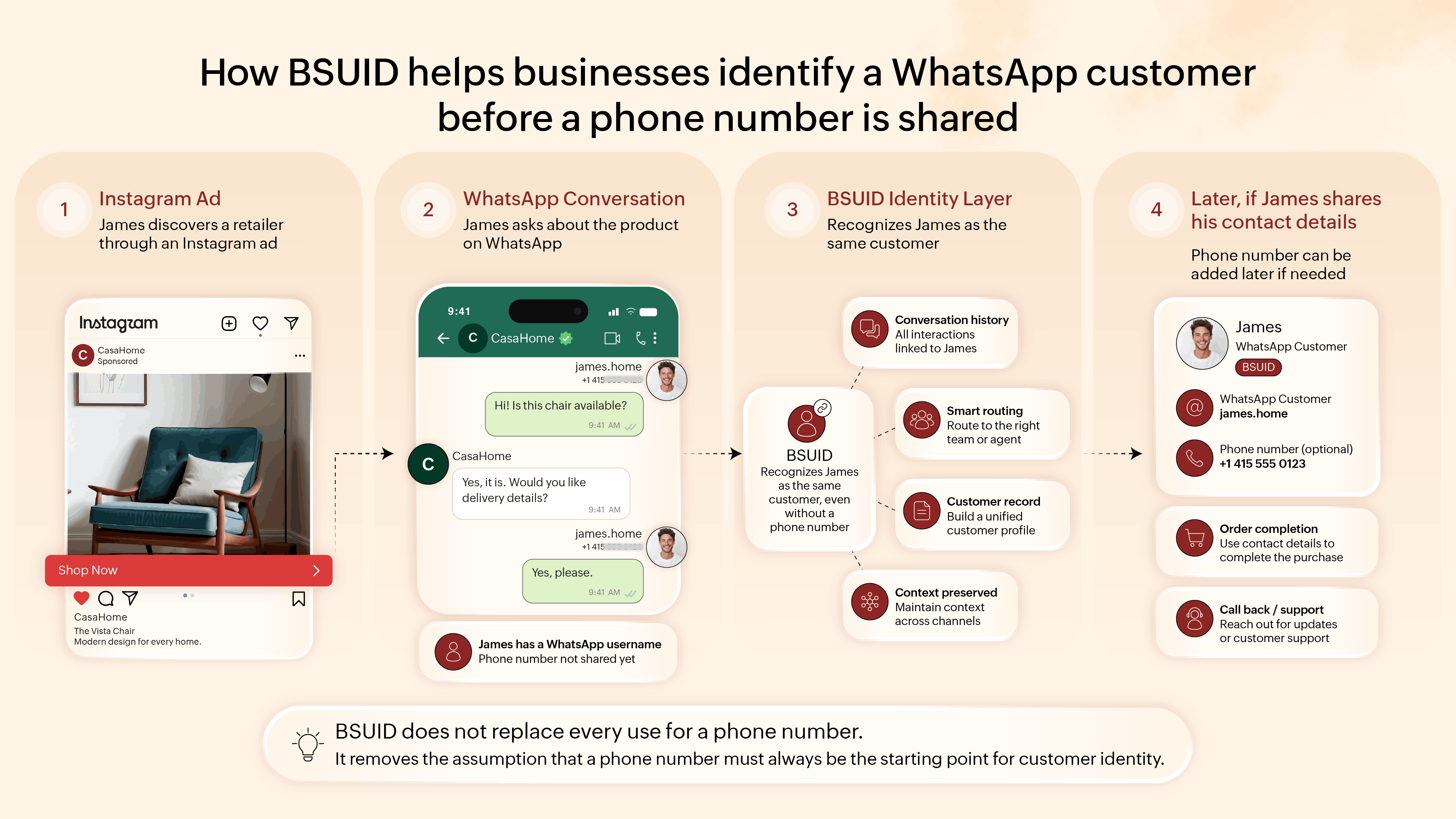
Consider a customer named James who discovers a retailer through an Instagram ad.
He taps the ad and starts a WhatsApp conversation. He has a WhatsApp username and has not previously shared his phone number with the business.
To James, nothing unusual has happened. He asked a question and received an answer.
Behind the scenes, however, the business still needs to know that the next message is from the same James who asked about that particular product a few minutes ago.
It may need to preserve his conversation history, route him to an available salesperson, remember information he provides, or connect the interaction to a customer record later.
The BSUID provides that identity layer even though James's phone number was not initially part of the interaction.
If he later chooses to share his contact details—for example, to complete an order or receive a call—the business can then work with that additional information as well.
BSUID does not replace every use for a phone number. It removes the assumption that a phone number must always be the starting point for customer identity.
What businesses should start thinking about
The change is a good opportunity to look at how heavily existing customer journeys depend on phone numbers.
Businesses should review whether their CRM, customer support, automation, attribution, and messaging workflows treat a phone number as the only possible customer identifier.
They should also understand how their WhatsApp Business Platform provider stores BSUIDs, maps them to known contacts when additional information becomes available, and maintains continuity when a customer does not share a phone number.
It is equally important to separate customer identification from outbound messaging logic. A known customer identifier does not remove WhatsApp's rules around when and how businesses can initiate or continue conversations.
And for organizations with custom WhatsApp integrations, APIs or webhooks that assume every incoming interaction contains a phone number should be reviewed as username adoption increases.
How Zoho SalesIQ fits into this shift
For businesses using WhatsApp through Zoho SalesIQ, the goal is straightforward: the operator should be able to focus on the conversation, not the identifier powering it.
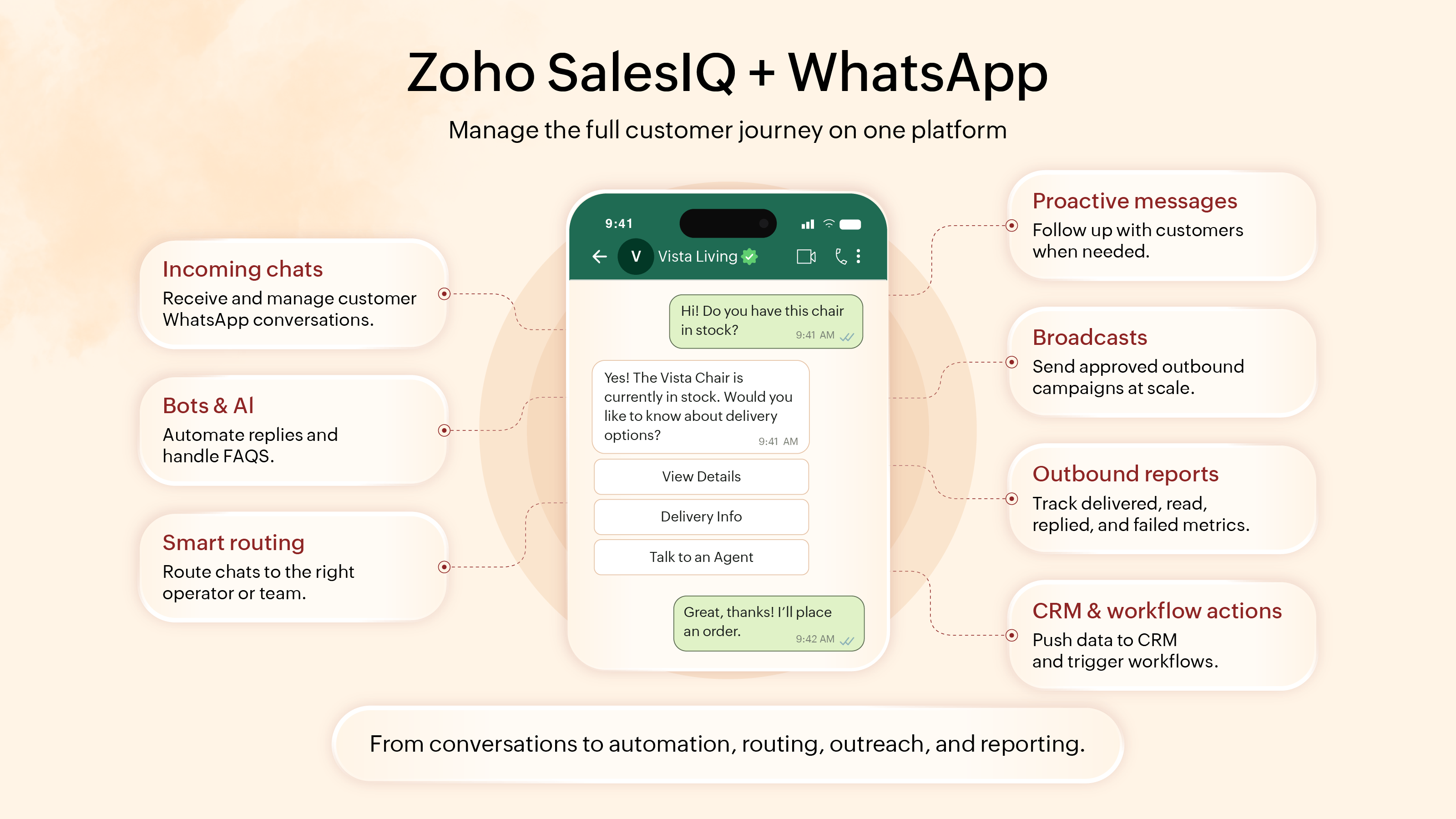
Zoho SalesIQ is an AI-powered live chat and chatbot platform that helps businesses manage conversations across WhatsApp, websites, mobile apps, and other messaging channels. On WhatsApp, businesses can handle incoming conversations, automate interactions with bots and AI, route customers to the right operator, send proactive messages and broadcasts, and track outbound performance.
As WhatsApp moves toward usernames and BSUID-based identification, SalesIQ supports this evolving identity model so conversations can continue even when a phone number is not available.
Where a phone number is available, it can remain part of the customer context. Where it is not, BSUID provides the identity needed to keep the WhatsApp interaction connected to the right customer conversation.
This matters because a WhatsApp interaction may involve routing, bot automation, operator handoff, CRM information, support workflows, or other actions. The identity layer underneath those experiences needs to evolve without disrupting the experience built on top of it.
For businesses and partners, the move to usernames is about making sure the underlying identity model is ready for a WhatsApp experience that is becoming less dependent on visible phone numbers.
From phone-number-first to customer-first
BSUID sounds like an infrastructure change. And technically, it is. But the reason it exists points to something much larger.
Business messaging is becoming a customer relationship layer in its own right. At the same time, platforms are giving customers greater control over how much personal information they reveal when those relationships begin. Those two movements need to coexist.
Customers should be able to start a conversation without unnecessarily giving up personal information. Businesses should still be able to recognize customers, maintain context, and deliver a continuous experience. That is the role BSUID begins to play.
The future of conversational engagement is unlikely to be about abandoning phone numbers altogether. They will continue to matter for many customer journeys. The shift is subtler—and more significant:
A phone number no longer has to be the customer identity itself.
For businesses building customer journeys on WhatsApp, understanding that distinction now will make the transition to the next generation of business messaging much easier.
References
[1] Meta — Be There for Every Customer With Meta Business Agent, June 2026
[2] Meta — How EU Over Regulation Is Stifling Business Growth and Innovation, August 2025
[3] Meta — Partnering With India’s Agency Ecosystem To Build Agencies Of The Future, April 2025

Comments