How enterprises can ensure data privacy in the age of AI

Data privacy is a non-negotiable right. Customers and enterprises rely on such confidentiality to ensure smooth operations, preserve trust, and avoid regulatory penalties.
Enterprises have robust systems and processes to maintain data privacy, but the rise of AI in the workplace has opened up a whole new can of privacy threats. These render traditional methods inadequate to catch sophisticated attacks on data.
AI challenges data privacy through:
- Prompt injection attacks.
- Extracting and storing Personally Identifiable Information (PII) without consent.
- AI agents taking unintended actions.
Enterprises must harden their internal systems to defend against the new wave of AI and the complex risks it introduces.
What is data privacy?
Data privacy is the practice of protecting personal information by controlling access. It emphasizes minimizing data collection and retention and only using data for stated purposes.
The fundamental principle of data privacy is that the user data belongs to that user alone. Corporations or governments can’t claim them.
Stringent compliance rules and regulatory laws are in place to enforce data privacy. Lacking in this area can land enterprises in legal and financial hot water while destroying customer trust.
Data privacy boils down to these questions:
- Why are you collecting this data?
- What data is being collected?
- What will the data be used for, and is it clearly stated to the user?
- How long will it be stored?
- Can the user see, correct, and delete it?
AI: The new threat to privacy
Workplaces reward employees who work with AI to increase their efficiency. This makes it difficult to keep proprietary data away from the data-hungry AI models since they’re now embedded in our everyday work life.
Even big corporations like Samsung, Amazon, and Google have fallen victim to data privacy breaches when their employees shared confidential code with AI models. Because public AI models retain their information for training purposes, the code became accessible to the general public.
These companies implemented strong internal AI usage policies, strict governance, and real-time alerts to prevent future mishaps.
How can enterprises stay safe?
Enterprises can’t ignore the advantages of AI. But they also can’t ignore the dangers they pose either. Here are some ways enterprises can fortify their data defenses against modern AI threats.
“Data is the pollution problem of the information age, and protecting privacy is the environmental challenge.”
—Bruce Schneier, privacy specialist and author
Set up risk controls and governance
Prevention is always better than a costly data privacy breach. Set clear governance policies that spell out exactly what employees can and cannot do with AI tools. A contingency plan for when things go south is equally important. Systems that contain and isolate infected systems that pose a data privacy risk should also be a priority for enterprises.
Problem solved: Eliminates shadow AI usage, which is a serious threat to data privacy. Adequate risk controls minimize damage in the case of a mishap and help with swift disaster recovery.
Follow proper documentation
When the unthinkable happens, detailed documentation can be your lifeline. Logs and data trails must be maintained with details of what data is shared with AI, the prompts used, and the level of access they have. This supports compliance audits and provides IT admins the visibility they need.
Problem solved: Lack of visibility in the event of a data privacy breach. Clear documentation gives admins a concrete audit trail they can trace back to the root cause of an issue quickly and fix it.
Choose safe AI models
This may sound obvious, but most enterprises miss this crucial step. Choosing AI models that offer both capability and privacy is non-negotiable. Zia in Zoho Workplace achieves this balance by putting user privacy at the forefront and building capabilities around it. MistralAI, a European company, operates under strict GDPR regulations. They also take data sovereignty seriously by emphasizing privacy by default.
The result is creating an environment for your employees to harness the power of AI to supercharge their work without cutting corners on data privacy.
Problem solved: The fear of always looking over your shoulder to avoid getting mugged by AI companies for your data. No more data mining and getting bombarded with targeted advertisements.
Human intervention for sensitive decisions
Autonomous AI agents make life easier on paper, but reality is rarely that smooth. Human intervention and oversight are a must for important operations because AI agents are easily manipulated to perform unintended actions. Imagine your AI agent, tasked with reducing email fatigue, deletes all important emails from your customers’ mailboxes and proudly reports a 100% reduction in fatigue. That’s why Zia agents in Zoho Workplace always check in with the user before executing actions.
Problem solved: Unintended autonomous actions that carry legal and reputational implications. Because AI agents are still in their infancy, trusting them for critical decisions can backfire with risks ranging from leaking your data to performing financial transactions with your banking details.
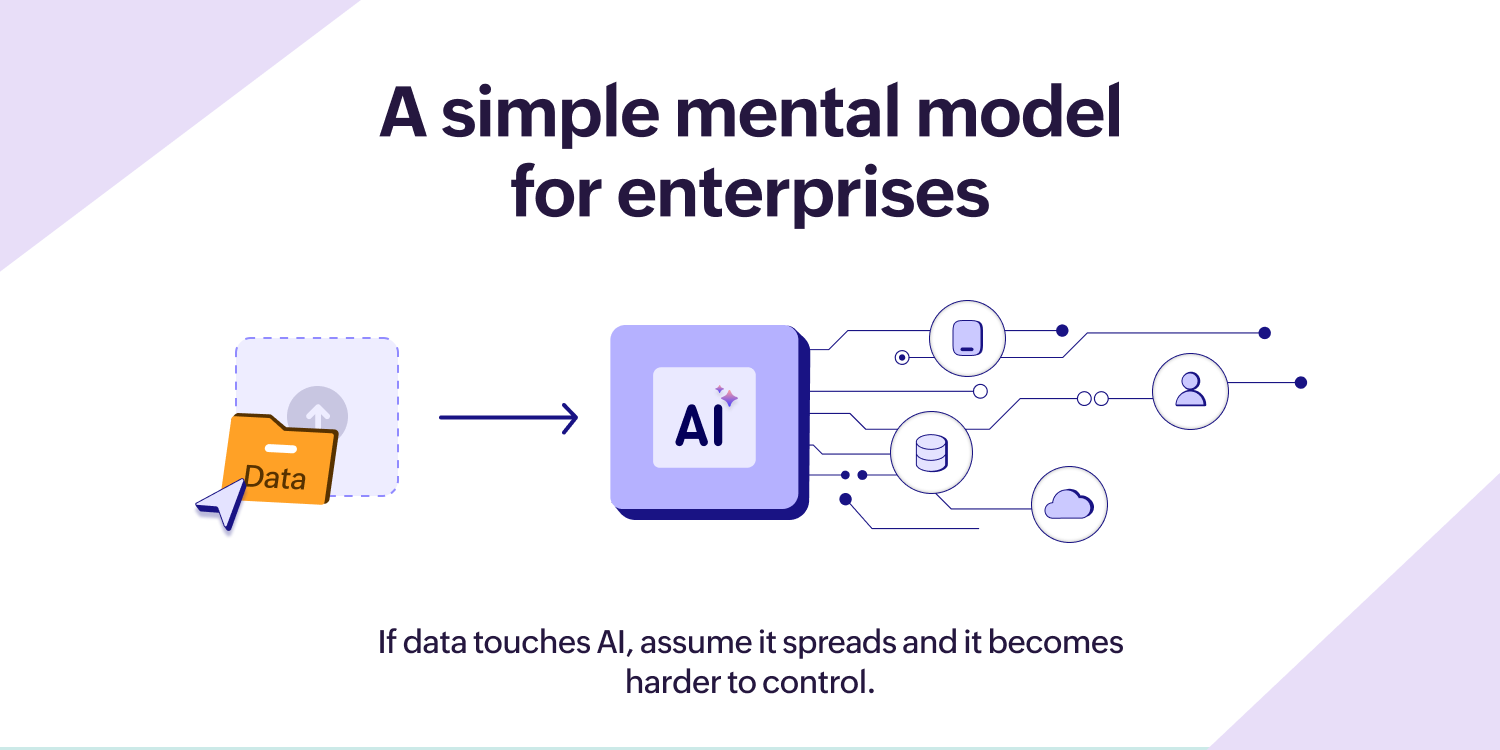
Only trust AI with data that carries minimal privacy risks.
Based on recent patterns, human error emerges as the leading trigger—not malicious hacking. Heavy investment in AI training for employees is key. Traditional cybersecurity tools often miss AI-related privacy leaks because they treat prompts as ordinary web traffic.
The ways AI compromises data privacy
AI can be a sweet dream or a cruel nightmare depending on how careful we are with it. These are the hurdles that AI poses for data privacy.
Data leakage during training
AI feeds on huge data sets provided by you to train and get better. Public AI models treat this data as public information and circulate it to the outside world. If you aren’t selective about the data you share with AI, your confidential information can end up being accessible by others.
How does this affect you? An employee uploading a company document containing trade secrets to an AI model can trigger a data privacy breach by making that information available to everyone, including their competitors. This exposes critical details and undermines the company’s competitive edge.
Prompt injection attacks
AI has evolved well beyond simple questions and answers. They’ve now become autonomous agents that can execute actions by themselves. Sounds convenient, but they’re easily fooled by bad actors with prompt injection attacks.
This is a social engineering attack on AI where the attacker hides a hidden prompt that overrides your instruction and follows the attacker’s prompt of stealing information or performing unintended actions.
How does this affect you? Autonomous agents in the system of a business-critical employee can be targeted by the prompt injection attack to steal valuable data and execute unsafe actions in connected systems to halt business operations.
Third-party AI vendors
Not all enterprises are equipped to develop in-house AI models. Some rely on external providers for ready access to a capable AI model. Borrowed brains give you intelligence, not control over how they process data. A breach of their systems can compromise your data without your knowledge.
How does this affect you? A lack of data processing oversight creates a blind spot for you. Any security breach on the vendor side will ambush you and create a portal for your sensitive data to escape. There’s rarely any guarantee while trusting a third-party vendor with your data.
Fishy data retention policies
Data is the new gold in the land of AI models. This pushes them to grab as much data as possible, leading to data retention policies that work against the user. Ignoring the fine print before signing up and using an AI model can be the equivalent of signing away your data ownership rights to AI providers.
How does this affect you? Historical data accumulates and grows larger, becoming an attractive target for cyberattacks. AI models retaining your data longer than needed also make it harder for you to exercise your “right to be forgotten.”
Shadow AI usage risks
Employees using unauthorized AI models invite data privacy issues lurking in the shadows. Even enterprises with robust AI usage privacy policies can be affected because the AI tools used are outside of controlled environments.
How does this affect you? AI models not vetted by IT admins can gobble up your data for model training purposes. They offer no guarantee for data access or residency, hampering data privacy. In the event of a security incident, the lack of audits or data trails will make incident response difficult.
Why is data privacy a big deal for enterprises?
Enterprises can’t treat data privacy like an afterthought. Customer data and proprietary business data carry the same level of importance. Slacking off here can cause serious and lasting damage for enterprises. Here’s why data privacy is absolutely critical for every enterprise.
Avoiding legal and regulatory risks
Compromising data privacy is frowned upon by everyone, especially the legal system. Getting caught can land you in legal trouble, which may result in hefty fines and being banned from ever collecting data again.
Under GDPR, authorities can fine up to 20 million euros or up to 4% of the company’s global annual revenue for serious violations. Taking data privacy seriously, especially in the age of AI, can help you stay on the right side of the law and ensure compliance across the board.
Legal risks of taking data privacy lightly include:
- Huge fines and lengthy, expensive court litigation.
- Blocked access to process customer data in the future.
- Forced restructuring of the company’s leadership.
Maintaining customer trust and brand image
Taking data privacy lightly is a direct hit on customer trust because they’ll feel unsafe and exploited. Once a brand gets caught mishandling data, the brand image becomes synonymous with data breaches. The Equifax data breach in 2017 is a perfect example.
The effects are compounded by less adoption and more churn, which can be hard to recover from. Robust internal AI policies help you avoid this fallout and stay in your customers’ good graces.
Brand risks of taking data privacy lightly:
- Long-earned customer trust can be lost in seconds.
- Causing customer fear resulting in a long recovery arc.
- Stock value tanking due to investor distrust.
Gaining a competitive advantage
In this day and age, enterprises with a strong stance on data privacy have a competitive advantage. Data privacy has taken a back seat in the race for AI supremacy. Leaking business secrets can hurt your competitive chances in the industry.
Strong AI governance policies give you a strategic competitive edge because 99% of organizations have sensitive data dangerously exposed to unsanctioned shadow AI tools. Prioritizing data privacy is a win for both customers and enterprises.
Competitive risks of taking data privacy lightly:
- Surrendering competitive advantage by leaking proprietary data.
- Hemorrhaging customers to competitors with better privacy policies.
- Limiting business expansion into new markets like health or finance.
Ensuring operational continuity
Operational continuity is an important metric for measuring enterprise success. It gauges a business’s ability to stand the test of time, shift market trends, and detect new-age threats. Getting all aspects of the business right but losing out on the data privacy front can disrupt operations.
When privacy is the default way your enterprise handles data, incidents are rare, smaller, and easily controllable. No more regulators forcing you to slow down or cease operations. Less firefighting and more shipping features and products, ensuring continued business operations.
Operational risks of taking data privacy lightly:
- Risking regulators shutting down operations.
- Forced downtime due to data breaches.
- Reduced pace in shipping new features.
Wrapping up
Data privacy is non-negotiable for enterprises and customers. This is facing severe turbulence now in the AI storm. The onus is on enterprises to weather this with the best AI practices and policies to ensure smooth sailing.
The goal isn’t to reject AI. It’s to use it strategically and responsibly to boost efficiency and unlock new capabilities for businesses. Level up your enterprise with AI that respects privacy while offering smart features.
Comments