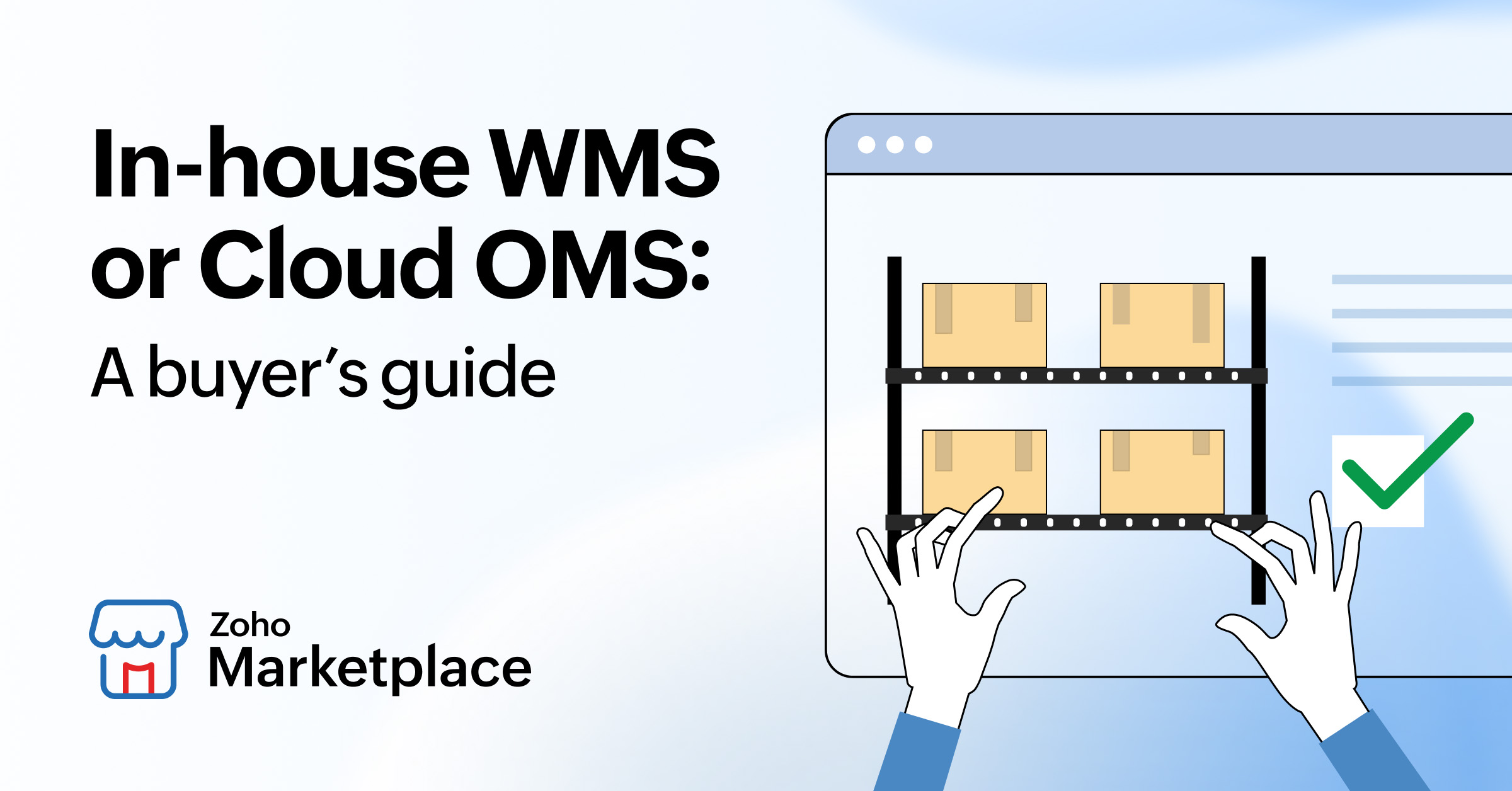
In-house WMS or Cloud OMS: A buyer’s guide

This is a guest post by Base.com
Most growing Indian retail and D2C brands reach the same fork: orders arrive from several marketplaces, like an owned storefront and a couple of quick-commerce platforms. The warehouse picks off printed lists, finance reconciles channel payouts by hand, and someone proposes building a warehouse management system in-house. Often, the pain described is not a warehouse problem at all.
Top 10 checks before you choose between in-house WMS or cloud OMS
Before you begin: Work through these in order because the earlier questions can provide useful context for the ones that follow. Most teams tend to arrive at their answer around check four or five. You may also want to involve the operations lead and whoever owns the engineering roadmap, since this commits both teams.
1. Know exactly what a WMS governs and what an OMS governs instead
A warehouse management system runs what happens inside a building: bin locations, putaway, pick paths, batch and expiry, and cycle counts. An order management system runs the journey around it: channel orders in, allocation, carrier selection, GST invoicing, tracking, and returns.
2. Diagnose whether the pain actually lives inside the warehouse or outside it
List the last ten escalations. Pickers walking too far or stock in the wrong bin is a warehouse problem. Oversells across channels, missed dispatch cut-offs, and invoices raised by hand are not.
3. Count your active sales channels before counting anything else
One or two channels, mostly offline or general trade, and a WMS may suffice alone. Add marketplaces, D2C, and quick commerce, and the bottleneck becomes orchestration. No amount of warehouse tuning fixes a stock feed that updates twice daily.
4. Audit your warehouse complexity honestly rather than aspirationally
Multi-zone racking, serialisation, cold chain, or kitting at scale justify a custom build. Four aisles and pallet racking do not. Be honest about which describes your operation today.
5. Check whether engineers are free for eighteen months and beyond
Don't check whether the team has engineers but whether they can be committed for eighteen months, then held on maintenance indefinitely. If they are also building the core product, they cannot.
6. Model integration maintenance cost, not just the one-off build estimate
Comparing a subscription fee to a development quote only prices version one. Channel APIs change without warning. Courier manifest formats change. GST rules change. Absorbing that churn is most of what a product delivers.
7. Ask how often operational requirements are likely to change each year
Warehouse layouts stay stable for years. Channel requirements change monthly: a new sales channel, a new courier, or a new compliance field. Build for the first, and you get an asset. Build for the second, and you get a permanent backlog.
8. Check whether every dispatch can produce a compliant document automatically
Quick-commerce platforms typically expect appointment slots and tight dispatch windows, and every dispatch needs a compliant invoice and an e-way bill where applicable. If the books sit in a cloud suite, the order system must write to it cleanly, including credit notes for returns.
9. Decide whether the real answer is running both systems side by side
Framing this as WMS versus OMS sends teams wrong. A pattern that works well is when the OMS orchestrates and the WMS executes. The OMS owns channels, allocation, documents and accounting sync. The WMS owns the physical work.
10. Prove the decision with a 30-day pilot before committing budget
Step | What to do |
Scope | One channel, one warehouse—not the biggest or the easiest |
Baseline | Manual touches per day, hours from receipt to dispatch, weekly stock-sync errors |
Re-measure | The same three numbers at day 30 |
Decide | If nothing moved, software was not the constraint |
Thirty days of measurement beats eighteen months of building, and it settles the argument with evidence rather than seniority.
A build can be justified when the complexity of your warehouse operations is something no existing product can adequately address. For most Indian multichannel brands in 2026, the practical answer is to buy the orchestration layer and spend the engineering budget on what is genuinely proprietary.
That is the layer Base is built to be. As an order management system (OMS), it sits between sales channels and the warehouse, handling order ingestion, allocation, shipping and documents, and it connects to Zoho so orders and invoices land where the finance team already works. Base's integration with Zoho Books helps Zoho Books users handle invoice generation and export while stock and price stay in sync across channels.
Comments