The quiet power of email marketing to maximize impact for nonprofits

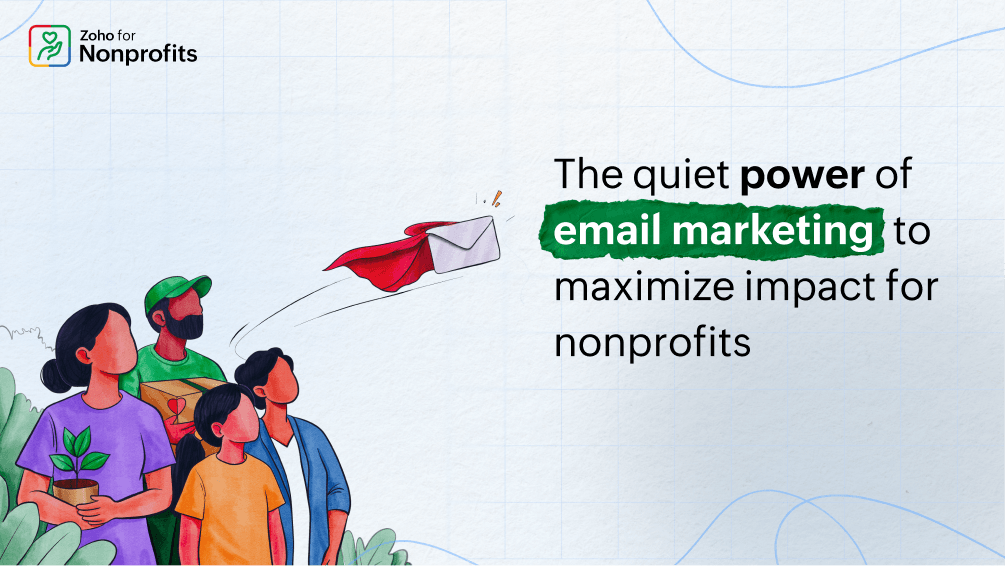
A life changed. A problem solved. A community strengthened. A future made a little better than it was yesterday.
For nonprofits, that's the metric. That's the "profit".
And it's real, even though it doesn't show up on a balance sheet. Every person helped, every problem eased, and every community strengthened is the "bottom line" for organizations doing this work.
Impact doesn't happen in isolation
Behind every nonprofit's mission is a web of people who make it possible: donors who fund the work, volunteers who show up to do it, advocates who spread the word, supporters who cheer it on, and the communities who ultimately benefit. But none of these relationships sustain themselves. They need tending.
So we have to move beyond "how do we create impact". Instead, we have to ask "how do we keep these relationships alive long enough for that impact to happen at all?"
The honest answer is consistent communication: fundraising campaigns, newsletters, thank-yous, event invitations, program updates, impact stories... a steady drumbeat that keeps supporters engaged between the moments they're asked to give or act.
The trap: Marketing that demands too much
Here's where many nonprofits get stuck. Small teams, limited budgets, and a mission that already asks for everything they have—and now marketing wants a piece too.
That tension is real, and it's worth naming plainly: An organization's mission deserves attention, but the marketing required to sustain it shouldn't demand all of that attention in return. When staying in touch with donors and volunteers becomes a second full-time job, something has to give—usually the very communication that keeps supporters connected in the first place.
This is where email earns its place as one of the most efficient tools in a nonprofit's kit. It's not flashy, but it does something few other channels can: It lets a small team reach, engage, and nurture an entire community at scale, without a proportional increase in effort.
From transaction to relationship
One of the more overlooked opportunities is what happens after someone gives. A donation is often treated as the end of an interaction—the ask succeeded, move on to the next campaign. But that's exactly backwards. The moment right after a gift is when a supporter is most emotionally invested, and it's the best possible time to show them what their contribution actually did.
This is the idea behind what's sometimes called an "impact email"—a message that closes the loop between a person's contribution and the outcome it helped create. Done well, it turns email from a broadcast channel into a bridge: a way of saying, concretely, "here's what you made possible." That single shift—from transactional acknowledgment to relational storytelling—is often what turns a one-time donor into a long-term advocate.
Bringing people in, not just reaching out
The same logic applies at the very top of the funnel. Someone stumbles across a nonprofit's cause—through a friend's share, a search, a chance mention—and in that moment, the organization has maybe one shot to bring that visitor into its orbit before they move on and forget. A clear, low-friction way to opt in (a newsletter signup, an update list, a way to hear more) is what turns a passing visitor into part of the ecosystem, rather than a missed opportunity.
The real takeaway
Impact, the thing nonprofits actually exist to create, is inseparable from relationships, and relationships require ongoing, low-friction communication to survive.
The nonprofits that get the most out of their limited time and resources are the ones that treat communication as infrastructure for their mission—automating the routine, personalizing the meaningful moments, and freeing up their people to spend more time on the work that actually moves the needle.
Because in the end, the work that matters should get more of an organization's time. Everything else—including the marketing—should be working quietly in the background to make that possible.
Zoho offers exclusive credits for nonprofits that cover up to 50% of your subscription costs. Check out Zoho for Nonprofits to get started.
Connect with other nonprofits from around the world to discuss Zoho tools, tech decisions, or anything else that's on your mind! Join our community
If you have any questions, write to us at: support@zohononprofits.com.

Comments