Get UAE eInvoicing ready with Zoho

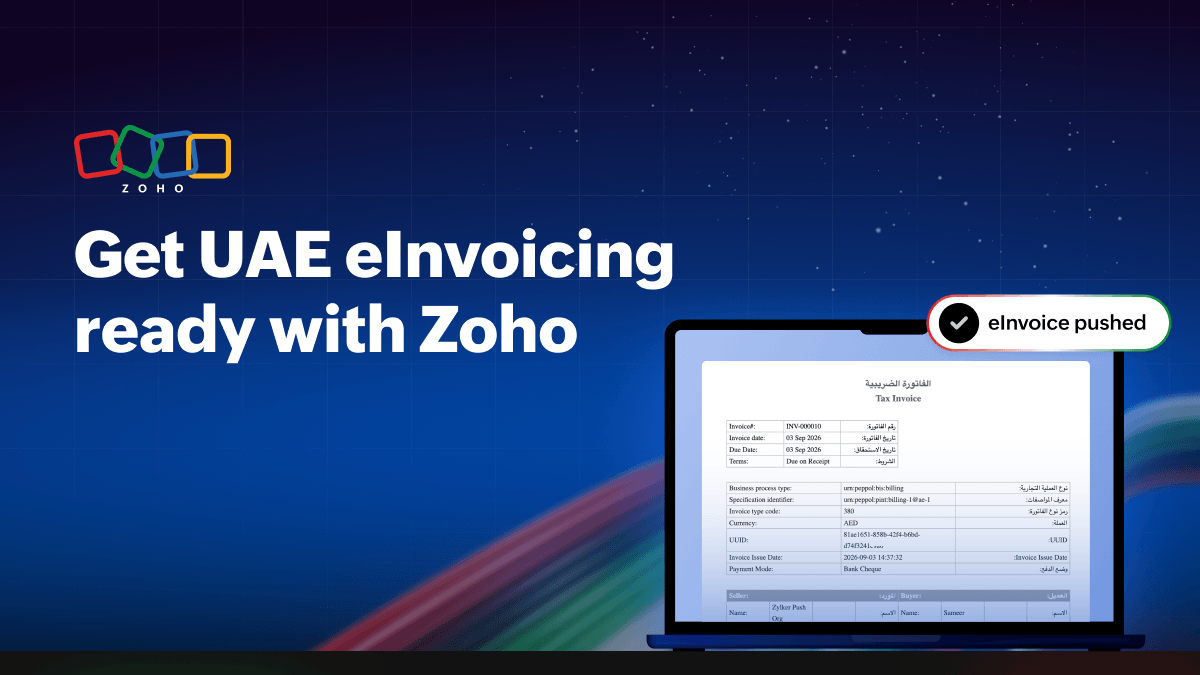
The UAE announced its eInvoicing mandate on 30 October 2024, when the Ministry of Finance issued Federal Decree-Laws No. 16 and 17 of 2024, laying the legal groundwork for a national eInvoicing system. Since then, the UAE has moved from establishing the framework to setting out a clear implementation timeline, with mandatory eInvoicing beginning on 1 January 2027 for large businesses (with annual revenue of over AED 50million)
This leaves finance teams with a fairly practical question. How do you meet this requirement without latching another system onto everything you already run?
At Zoho, we addressed that. Zoho Software Trading LLC is accredited by the UAE Ministry of Finance as an eInvoicing Accredited Service Provider (ASP), so accounting and eInvoicing can sit in one workflow instead of two. Our aim is straightforward: eInvoicing should be part of managing your finances, not a separate process your team has to build around.
What UAE eInvoicing actually requires
An eInvoice is structured data, exchanged electronically between supplier and buyer in PINT-AE format and reported to the Federal Tax Authority. A PDF doesn't count. Neither does a scanned copy or an emailed invoice, no matter how well formatted it is.
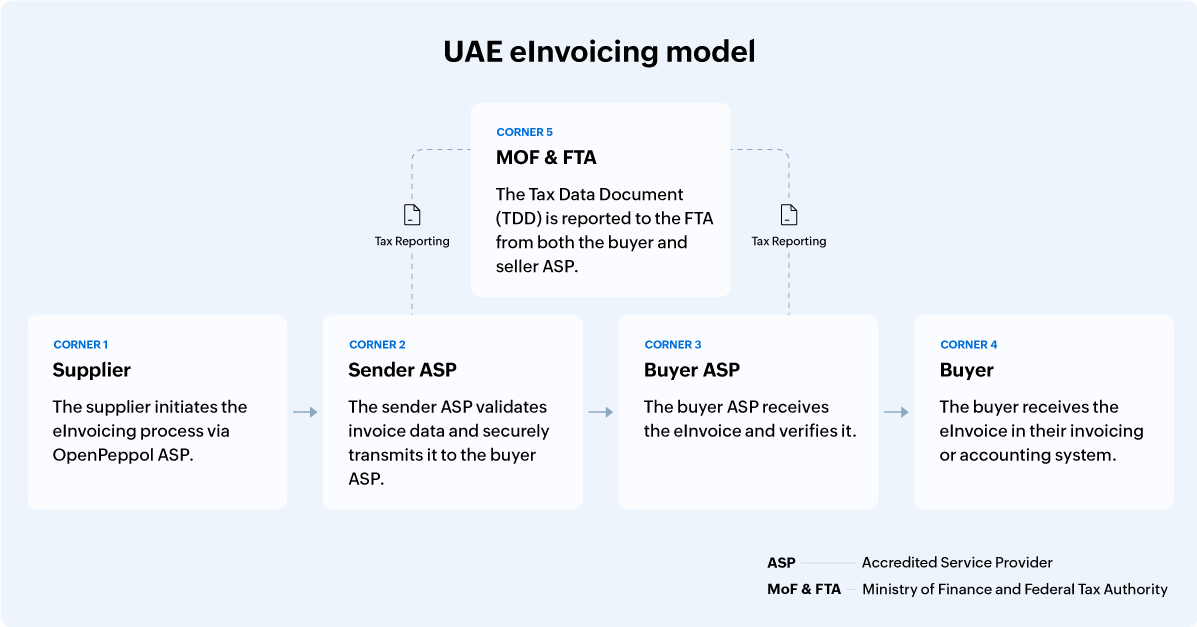
The framework runs on what's called a five-corner model:
- The supplier creates the invoice.
- The supplier's ASP validates it and prepares it for exchange.
- The buyer's ASP receives and validates it.
- The buyer receives the eInvoice.
- The FTA receives the tax data it needs.
That exchange happens over the Peppol network, and invoices follow PINT-AE, the UAE's version of the Peppol International Invoice standard. Your ASP handles the exchange between the supplier and buyer, and the shared standard keeps the data readable on both ends. Most of it happens in the background. What you need to get right is choosing an accounting system and ASP that handle this properly without disrupting how you already work. And Zoho Books acts as both for you!
The timeline
Deadlines are staggered by business size. Here's where things currently stand, per the Ministry of Finance's confirmed schedule:
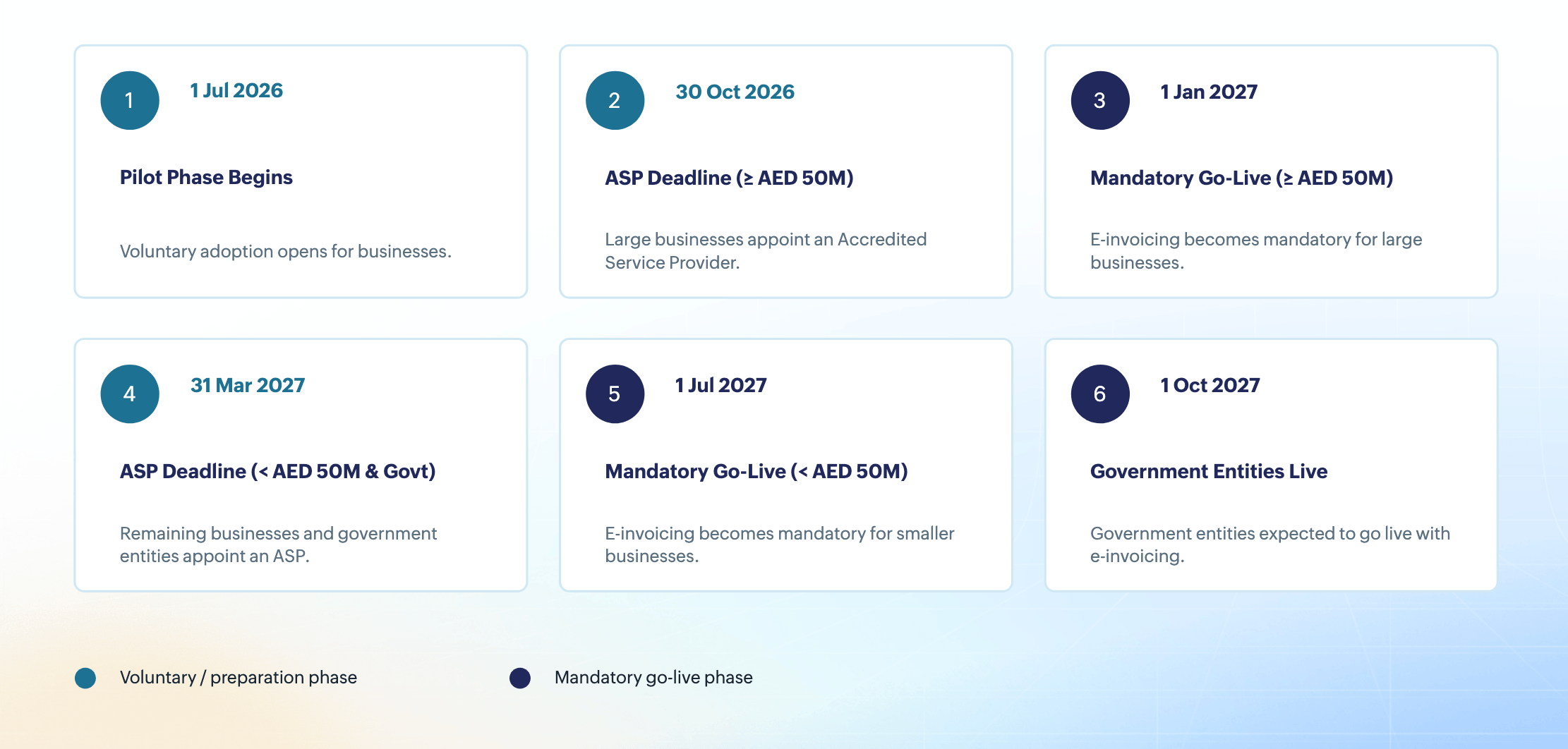
Two things worth knowing. First, the ASP appointment deadline for large businesses (revenue over AED 50M) already got pushed once, from 31 July 2026 to 30 October 2026, but the January 2027 go-live date hasn't moved. Second, B2C transactions and a handful of exempt categories currently sit outside the mandate. B2B and B2G invoicing are what's in scope.
If your revenue puts you in Phase 1, October is closer than it looks once you account for testing and data cleanup. Businesses that start early tend to find their data issues before those issues become compliance issues, not after.
Why the ASP you pick matters
An ASP validates your invoice data, converts and transmits it in the required format, moves it through Peppol, and supports the reporting the FTA expects, continuously, in real time, for every invoice you issue. The Ministry of Finance holds ASPs to specific technical and security requirements before accrediting them, so this isn't a decision to make on price alone.
Before you commit to one it is worth asking, how well does it work with the accounting system you already use? How much retraining does your team need? Do your existing invoice workflows survive the switch, or get rebuilt from scratch? And how much ongoing effort goes into keeping two separate systems in sync, month after month Here is where Zoho Books has an edge, your accounting software and your accredited ASP are the same product. You're not creating an invoice in one place and pushing it through another.
If you are already on Zoho, you don't need to start over. Your customers, vendors, invoices, bills, payments, expenses, banking, and VAT records are already in Zoho Books, and eInvoicing becomes part of that same record rather than a second one running alongside it. Treat the transition as a good excuse to tidy up. Check that customer and vendor details are up-to-date, confirm TRNs/TINs are correct, update the item codes, and clean up any workflows eInvoicing will touch. Once that's done, you can create, send, receive, and manage eInvoices directly from the product you're already using.
For your finance team, that's fewer systems to learn and less data moving between applications. One single view of a transaction instead of two half-views that need reconciling.
Zoho: Built to help you stay eInvoicing compliant
Connect to the Peppol network
Choose Zoho as an ASP in Emaratax portal and connect your Zoho Books organisation to the Peppol network to exchange eInvoices with your customers and vendors.
Create and send compliant eInvoices
Create and send B2B and B2G eInvoices in the required PINT-AE format, with the necessary UUIDs generated as part of the process.
Receive eInvoices
Fetch vendor bills issued to your organisation through the eInvoicing network and bring them directly into Zoho Books, reducing the need for manual data entry.
Handle credit notes
Create and process credit notes for invoice adjustments and rectifications while keeping them connected to your accounting records.
Keep VAT and accounting connected
Your eInvoices, VAT information, payments, and accounting records stay connected in one system, giving your finance team a consistent view of every transaction.
Manage eInvoicing within your existing workflows
Approval workflows, automation, customer and vendor records, and other accounting processes continue to work alongside eInvoicing, so your team doesn't have to build a separate process around the mandate.
Beyond compliance
An invoice is a small record of a lot of things. What you sold, who bought it, what you collected, what's still owed, how the business is actually doing. Connect that to your accounting and it stops being just a compliance artifact. Structured invoice data cuts down on manual entry and reconciliation, and keeps your records up-to-date without someone chasing documents. That compounds as you grow. The real opportunity in eInvoicing isn't the new requirement itself, it's a simpler way of running your finances, which happens to come with a deadline attached.
Start now
The shift to eInvoicing is significant, and the timeline is already moving. Getting ahead of it gives your team room to understand the requirements, clean up data, review workflows, and lock in an ASP before your deadline is the only thing left to deal with.
With Zoho, accounting, business finance operations, and eInvoicing move together. One workflow, one accredited provider, nothing extra to manage. Get eInvoicing-ready with Zoho.
Visit our pricing page to learn more about the eInvoicing add-on, and signup to our eInvoicing compliant finance suite for free!
For any questions about eInvoicing, our support team is here to help. Write to support.me@zohobooks.com

Comments